Why We’re Building in Public Before the Polish Is Done
Why we chose to start the conversation about Distl before the interface is finished — and what we hope to learn by treating polish as something a product earns, not something it ships with.
The safest time to talk about a new product is usually after the difficult decisions have been made. The interface has been refined, the demonstration rehearsed and the uncertainties that shaped the product removed from view. What remains is a coherent story in which progress appears more linear than it really was.
At Insaltix, we have chosen to begin the conversation earlier.
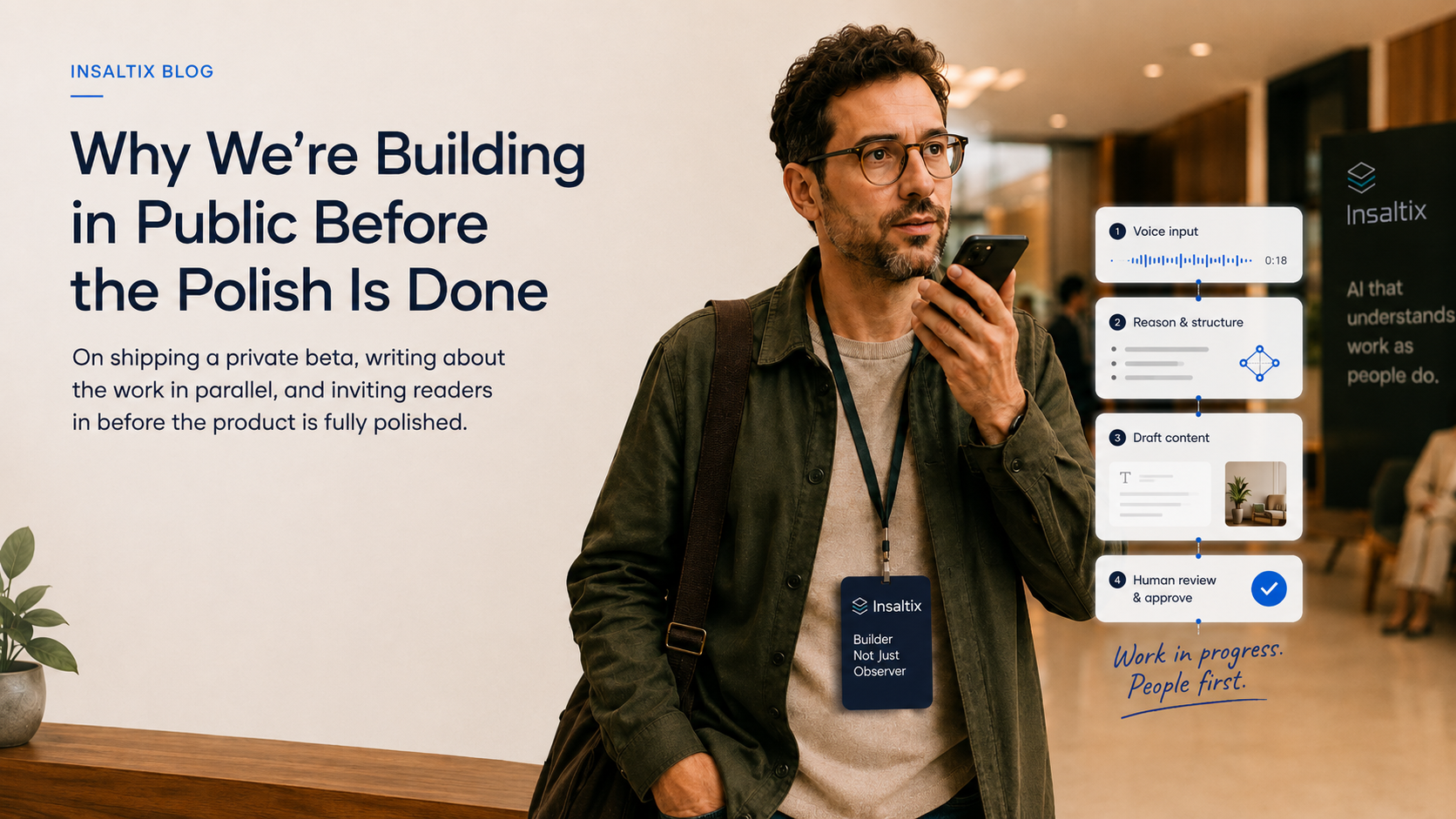
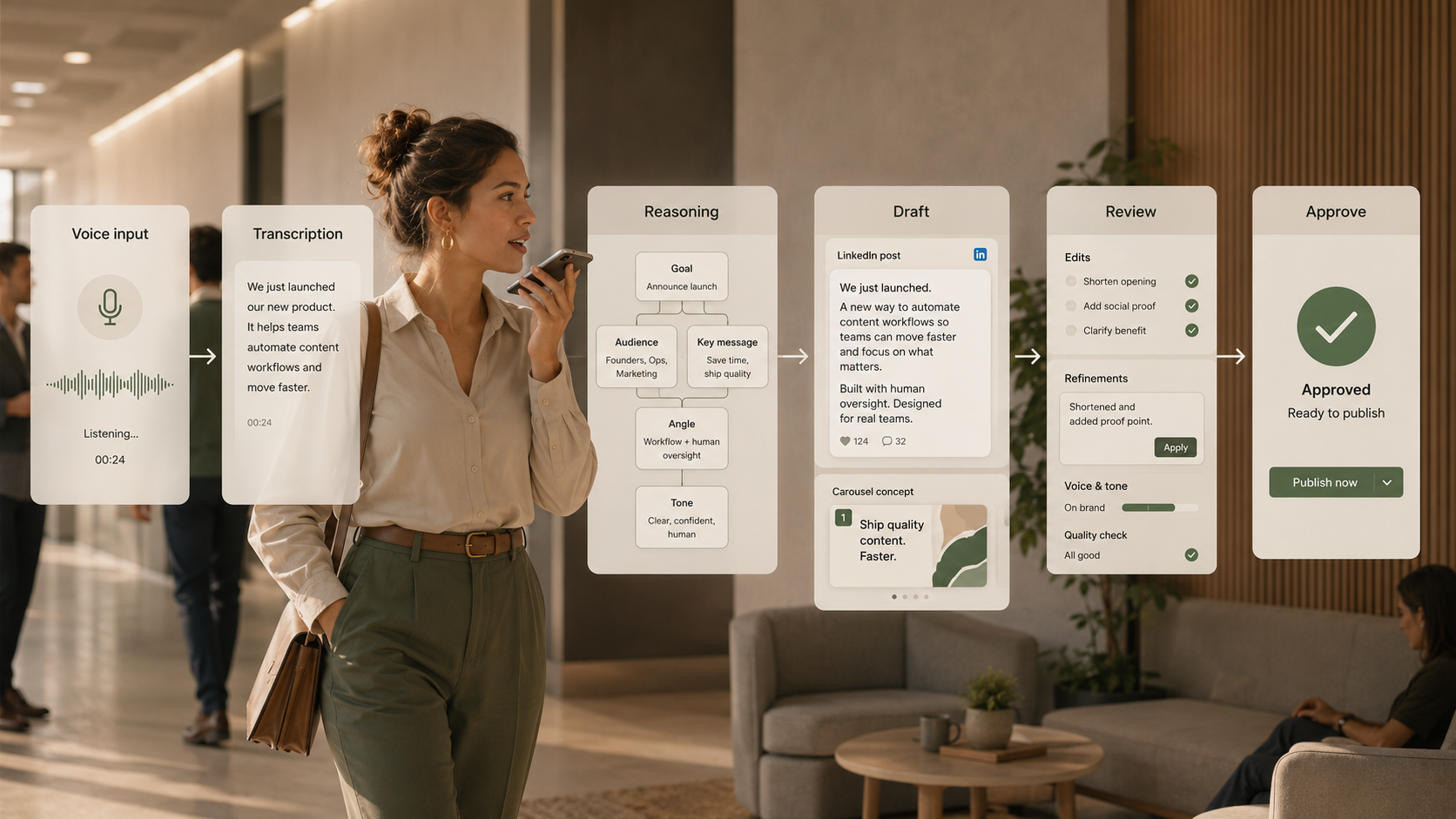
We are building multimodal, agentic AI products that reduce friction in everyday workflows. Our first product, Distl, allows professionals to speak naturally for a few minutes and turn those thoughts into structured content, including LinkedIn posts, articles, carousels and supporting visual assets.
Distl is currently being developed through a private beta. At the same time, we are writing about the product decisions, technical challenges and wider principles guiding the work.
This is not an attempt to turn product development into a continuous marketing exercise. It reflects a more practical belief: many of the decisions that determine whether an AI product will be useful, trustworthy and commercially relevant are made long before the product looks finished.
A private beta is not the same as building in secret
Distl begins with a simple observation. Many professionals have valuable ideas but do not always have the time, environment or headspace to turn them into publishable content.
An insight might emerge while travelling between meetings, walking through a conference, attending a trade exhibition or reflecting after a customer conversation. These are often the moments when an idea is most immediate, but they are rarely convenient moments for sustained text input.
By the time there is an opportunity to sit down and write, the detail may have faded. The energy behind the idea may have been lost. In other cases, the thought is still present, but the blank page creates its own barrier.
Distl is designed to reduce the distance between having an idea and expressing it clearly.
A user can speak while the thought is still fresh. The audio is then transcribed, interpreted and developed into structured content. LinkedIn will be the first supported social media platform, with others to follow. The same source material can also be transformed into longer articles, carousels and relevant visual assets.
The user remains in control throughout, with the ability to review, edit, publish immediately or schedule the content for later.
The experience should feel simple. The system beneath it is not.
Spoken thought rarely arrives as finished prose. People naturally:
- hesitate or repeat themselves;
- revise an argument while speaking;
- assume context they have not explicitly stated;
- move between several related ideas;
- discover the real point only after talking through it.
A useful agent cannot merely tidy a transcript. It must identify the central argument, distinguish useful detail from verbal noise, select an appropriate structure and preserve the perspective of the person speaking.
That last point is particularly important. The objective is not to replace the user’s voice with a generic AI writing style. It is to help the user express their own thinking with less friction.
A private beta gives us the conditions required to examine whether the system is achieving that.
A product metric might tell us that someone regenerated a draft. A conversation with that user can tell us whether the system misunderstood the argument, selected the wrong format, simplified the content too aggressively or produced something polished that no longer sounded authentic.
For a product that works with people’s ideas, professional identity and public communication, that context matters.
Writing about the work is part of the work
Throughout my career, I have found that complex technical decisions become clearer when they must be explained beyond the immediate project team.
Writing exposes assumptions. It reveals where technical sophistication is being mistaken for user value and where an apparently minor design choice carries broader consequences.
This discipline is particularly relevant to agentic AI, where the language of possibility is often moving faster than the evidence of reliability.
A controlled demonstration can show an agent completing a task successfully. A dependable product must also handle ambiguity, incomplete context, conflicting instructions and outputs that appear plausible while missing the user’s actual intention.
Writing publicly forces us to ask questions such as:
When should the agent act, and when should it ask for clarification? What should remain editable? How should uncertainty be communicated? At what point does automation begin to remove meaningful user control?
These are not abstract questions. They influence whether an agent becomes dependable infrastructure or remains an impressive demonstration.
Sharing some of this reasoning also creates a record of how our thinking develops. Most product stories are reconstructed after the outcome is known. The abandoned ideas disappear, the incorrect assumptions are forgotten and the eventual direction begins to look inevitable.
Early-stage product development is rarely like that. It is a sequence of decisions made with incomplete evidence. Writing about those decisions while they remain open to challenge creates a useful form of accountability.
Considered openness, not radical transparency
Building in public is often treated as an uncomplicated virtue. In practice, it introduces genuine trade-offs.
Openness can create accountability, but it can also create pressure to defend ideas that should remain provisional. Early demonstrations can build interest, but they may also be interpreted as commitments. Public feedback can reveal blind spots, but the most visible opinion is not necessarily the most representative one.
There is also a danger that public progress becomes performative. Teams can begin optimising the appearance of momentum rather than the quality of the product. Updates become more important than outcomes, and demonstrations become more important than reliability.
We want to avoid that.
For Insaltix, building in public does not mean sharing everything. It means being open about the problems we are investigating, the principles guiding our choices and the lessons that may be useful to others.
It does not mean publishing private user information, exposing security-sensitive details or presenting unvalidated capabilities as finished features. Nor does it mean allowing every public reaction to redirect the product roadmap.
The aim is not radical transparency. It is considered openness.
Why show the product before it is finished?
Recently, I shared a brief LinkedIn post showing Distl’s carousel-generation agent in action. It was intentionally presented as a sneak peek rather than a launch announcement.
The distinction matters.
The carousel made one part of the product tangible. Instead of describing an abstract system capable of turning spoken ideas into professional content, we could show a visible output beginning to emerge from the workflow.
However, one successful carousel does not prove that the whole system is finished. It does not demonstrate that every input will be interpreted correctly, that every argument will be structured effectively or that every output will preserve the user’s voice.
It shows that one part of a broader agentic system is taking shape.
That is why selective demonstrations can be useful. They give readers something concrete to examine while allowing us to remain precise about what is still being developed.
Agentic products also require a different kind of trust from conventional software. A traditional tool performs a relatively bounded operation. An agent may interpret intention, choose a format, sequence multiple tasks, generate alternatives and recommend what should happen next.
As more judgement is delegated to the system, the judgement of the people designing it becomes more important.
Users should understand how we think about authorship, ambiguity, control and failure before we ask them to rely on the product at scale. Human review is therefore not simply an inconvenience waiting to be automated away. Where professional identity and public communication are involved, review and approval can be deliberate parts of the design.
The objective is not to automate the individual out of the process. It is to reduce the friction between thought and expression while preserving ownership of the result.

Before polish becomes concealment
There will be more polished versions of Distl, clearer demonstrations and capabilities that we are not yet ready to discuss. Insaltix is also developing other agentic AI products for high-friction problems where multimodal interaction can make software feel less like a form to complete and more like a capable collaborator.
But polish should arrive after the product has earned it.
A smooth interface can conceal weak reasoning. A confident output can make uncertainty difficult to detect. A carefully selected demonstration can create the appearance of reliability before reliability has been established.
In agentic AI, some of the most important work is also the least visible: retaining context, handling ambiguity, recovering from failure and deciding when the system should stop and return control to the user.
That is the work we intend to discuss.
The private beta protects the conditions required for careful learning. Public writing makes the reasoning visible. Selective demonstrations make the direction tangible without pretending that the destination has already been reached.
The polish will come. The conversation should begin before it does.
To follow the development of Distl and the wider Insaltix product portfolio, follow Insaltix on LinkedIn or register your interest in the Distl private beta at insaltix.com.