From Voice to LinkedIn: Why Transcription Was Only the Beginning
What building Distl taught us about the gap between capturing a thought and turning it into content worth sharing.
One of the assumptions we made early while building Distl was that accurate transcription would solve a large part of the problem.
The logic seemed reasonable. Many professionals already have useful ideas, observations and experiences to share, but turning those thoughts into a LinkedIn post often starts with an inconvenient ritual: finding the time, opening a laptop and staring at a blank page while trying to decide how to begin.
Distl, the first product being developed by Insaltix, starts somewhere else. Instead of asking the user to write, it allows them to speak naturally while the idea is still fresh.
Getting those spoken words onto the screen turned out to be the relatively straightforward part. What happened afterwards became much more interesting.
Spoken ideas rarely arrive ready to publish
People do not usually speak in finished paragraphs. We repeat ourselves, change direction, add important context late and sometimes only discover what we really think after talking for a minute or two.
That is not necessarily poor communication. It is often simply what thinking sounds like before it has been organised.
Our own test recordings made this obvious. The transcript could be accurate while still containing several versions of the same thought, unfinished sentences and a central idea buried somewhere in the middle.
That is precisely why voice is useful. It removes the expectation that the user must already know how the finished piece should sound before they begin.
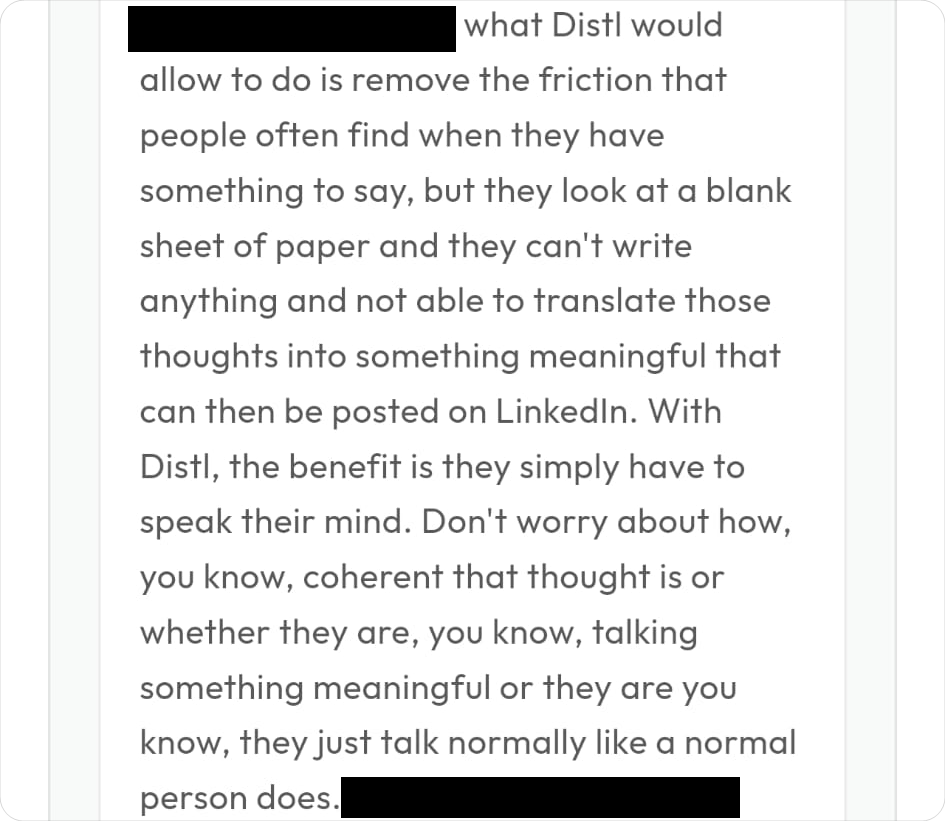
The blank page asks for structure immediately. Speaking does not.
For us, that distinction has become increasingly important.
A clearer post can create a different problem
Turning a loose spoken reflection into a structured LinkedIn post creates another balancing act.
Stay extremely close to the original recording and the result may preserve the speaker perfectly while carrying too much context, repetition or a slow route to the point. Move too far towards polished social content and the draft can become more engaging while gradually sounding less like the person who originally spoke.
Our current Distl MVP makes a meaningful step across that gap. It takes a spoken reflection and gives the user something structured and usable to work with instead of an empty page.
Here is one example from the same recording.
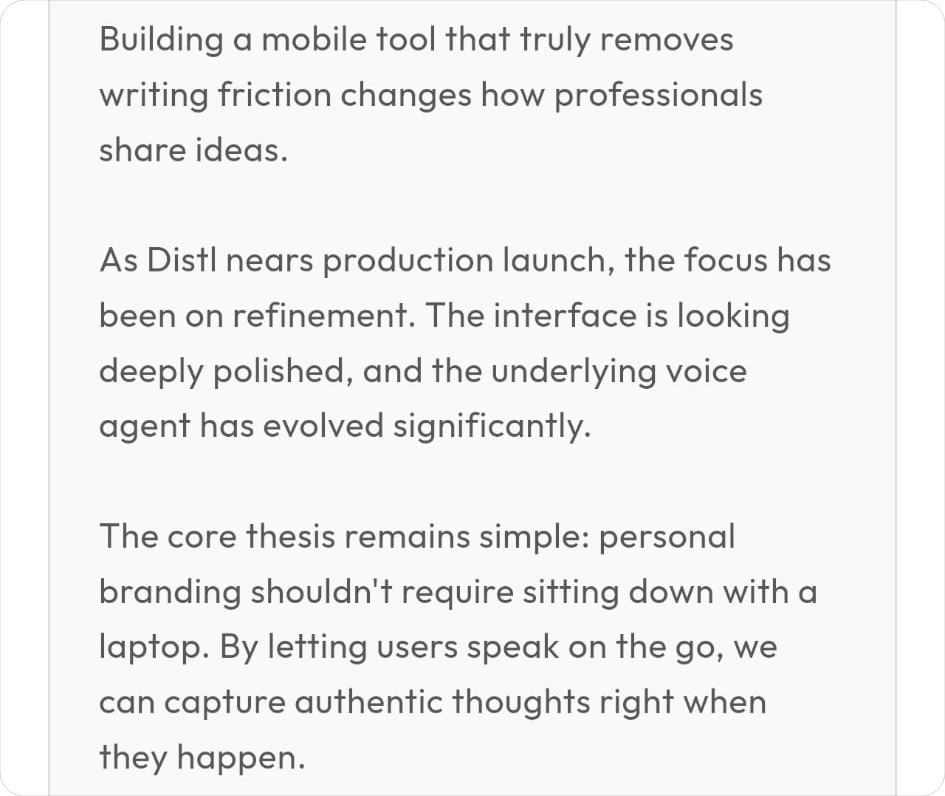
The transformation is useful, but it has also shown us where the harder problem lies.
Good writing and faithful representation of the speaker are not automatically the same thing. Nor is engagement on LinkedIn, by itself, a useful definition of success. A post might earn attention while feeling slightly foreign to the person whose name appears above it. Equally, an authentic idea may never get the attention it deserves if the reader has to work too hard to find the point.
That tension is something we intend to keep working on.
For the MVP, however, we have made a conscious product decision not to chase perfection before getting Distl into people’s hands. Additional processing can bring additional cost, latency and complexity, and every early-stage product eventually reaches the point where another improvement has to be weighed against the value of actually launching.
The question became less about whether Distl could produce the theoretically perfect draft and more about whether it could already remove a meaningful amount of friction.
We believe it can.
A user can speak while walking, between meetings or whenever an idea occurs, and arrive at a structured draft without first having to sit down and work out how to start. They remain free to change the wording, restore something that matters to them or take the post in another direction entirely.
That is already a considerably better starting point than a blinking cursor.
The visual should feel part of the idea
We have found a similar principle applies to visual content.
It is relatively easy to produce an attractive image. The harder question is whether that image actually belongs beside the post.
Professional content is full of familiar visual shorthand: mountains for ambition, arrows for growth and groups of people around glass walls for collaboration. These images can be polished while remaining interchangeable.
For Distl, we want the visual side of the experience to feel more considered than that. The aim is not simply to add an image because social media content is expected to have one. The image should contribute something to the way the idea is experienced.
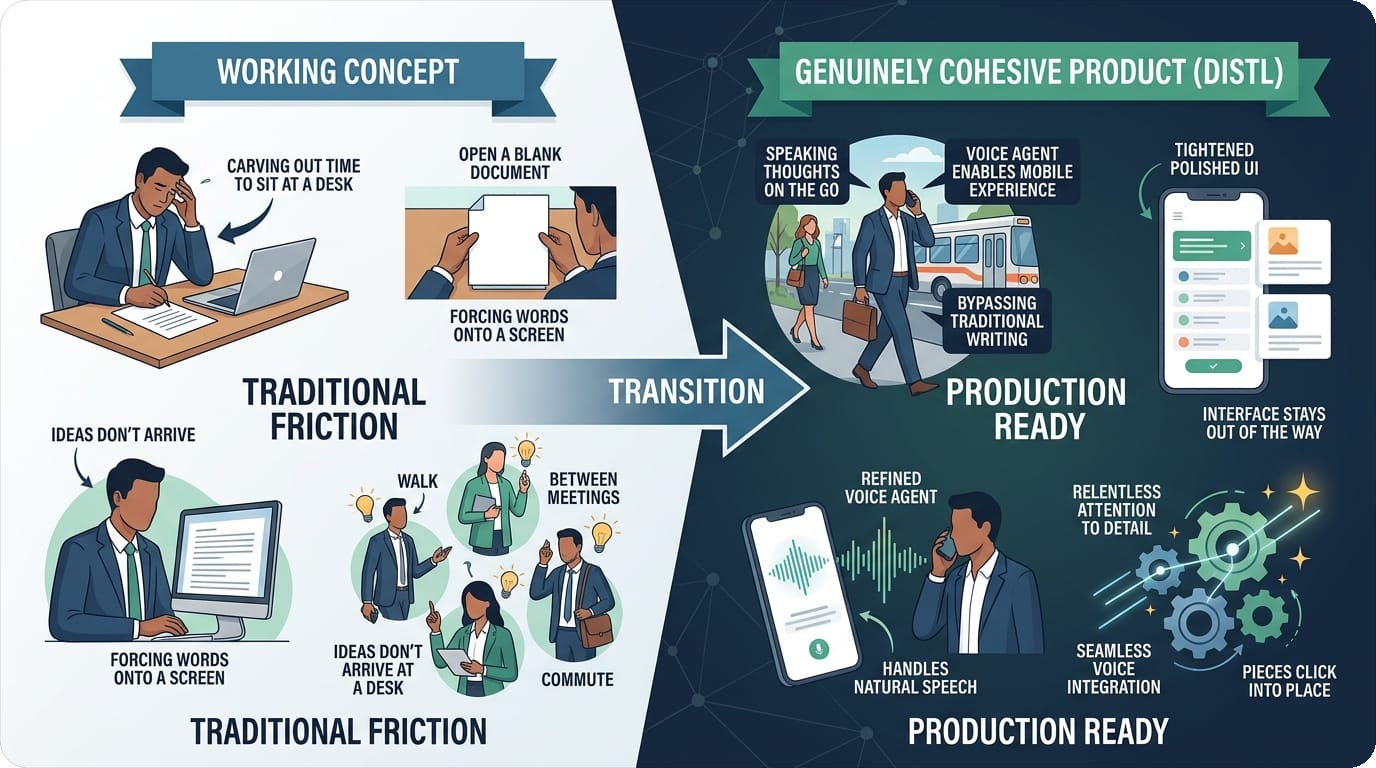
Sometimes that may be a strong visual metaphor. At other times something simpler may work better. The format matters less than whether the result feels intentional.
The MVP is a starting point, not a claim of perfection
Building Distl has reinforced something we wrote about when we first explained why Insaltix was choosing to build in public: individual parts of an AI product can appear to work while the more interesting product questions remain unresolved.
A transcript can be accurate. A draft can be polished. A visual can look impressive. None of those things, on their own, guarantee that the finished experience is useful.
The product has to work as a whole.
That is also why we are comfortable showing the real transcript, the real generated post and the resulting visual together. They give a much better picture of where Distl stands today than a perfectly staged demonstration would.
There are things we want to improve. There are trade-offs we have deliberately accepted for launch. There are also parts of the experience that already solve a real problem.
Building in public, for us, means being open about all three without exposing every decision taking place underneath the product.
Reducing the distance between thought and expression
The problem Distl is trying to solve remains remarkably simple to describe.
People have useful things to say at moments when writing is inconvenient.
Voice gives them another way to begin.
The current MVP turns that spoken thought into a usable LinkedIn draft and supporting visual content, while leaving the user in control of what eventually carries their name.
Over time, we want the distance between the original thought and the finished piece to become smaller still: clear enough for an audience, useful enough to publish and recognisable enough to remain the user’s own.
For now, getting someone from an idea in their head to something tangible they can work with is a meaningful place to start.
That is where Distl is today, and it is the next part of the journey we are looking forward to testing with real users.